
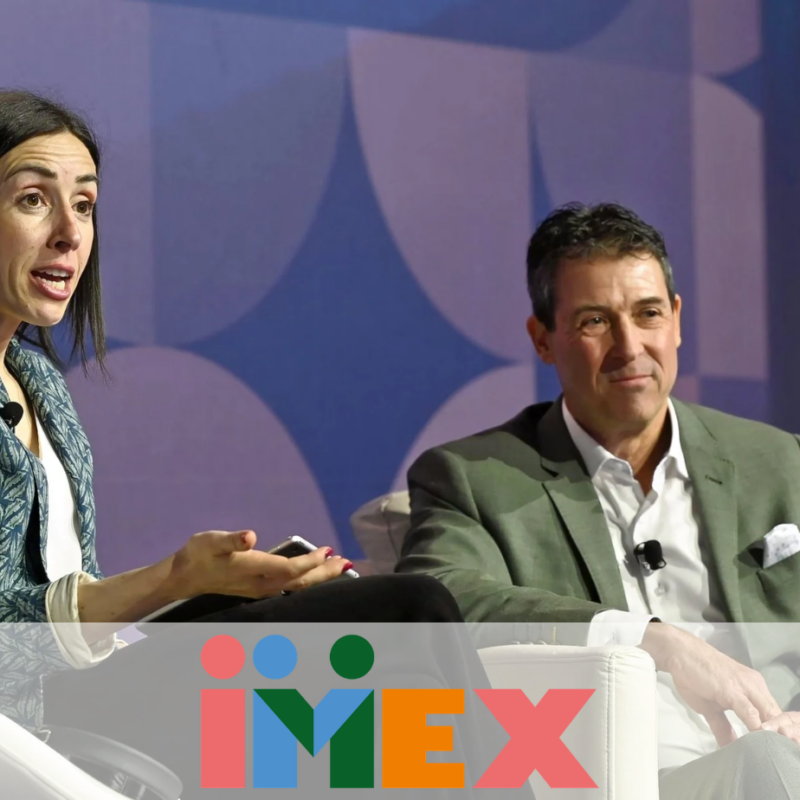
Holly Ransom, CEO, Emergent Global, and trusted moderator for global leadership forums, gives us her take on IMEX America 2025.
There was something different about IMEX America this year.
Walking the floor in Las Vegas two weeks ago, I felt a palpable shift in energy—more confidence, sharper focus, genuine optimism. Conversations weren’t dominated by survival-mode thinking. Instead, people were leaning forward, sharing wins, exploring what’s next. It was energizing to witness an industry not just bouncing back but genuinely thriving.
Under IMEX Talking Point, Impact 2.0: Activating the Future, I had the privilege of exploring what leadership really looks like when certainty isn’t part of the equation—through a talk and two candid conversations that cut right to the heart of that challenge.
Building your emotional AQ
In my talk, I shared strategies that top leaders use to manage their emotional AQ (adversity quotient): how well you navigate your own emotions during change while helping others through uncertainty’s emotional toll.
Drawing from my work with world leaders, Olympic champions and transformative CEOs, we explored three practical levers: micro recovery, return on energy (not just time) and “to-test lists” that replace overwhelming to-do lists with experiments worth trying.
Leading in extreme times
That theme continued in my panel exploring the IMEX report How to Lead with Impact in Extreme Times, featuring Carina Bauer, CEO, IMEX Group; Dr. Ferron Gray, President, Grae Matta Foundation, and Don Welsh, President and CEO, Destinations International. We explored how the clearest leaders don’t raise their voices in a noisy world—they prioritize clarity, listen deeply, and sometimes slow down to see possibilities others miss in the rush.
One line from Ferron captured it perfectly:
“We don’t get to choose the pressure, but we do get to choose our priorities.”
At the center of our discussion was this truth: high-impact leaders aren’t trying to outrun uncertainty—they’re building clarity within it. And critically, they’re doing the internal work themselves, modeling consistency and courage that teams need to see. Not commanding from the front, but serving from within.
What Cirque du Soleil can teach us about agile leadership
While the panel explored the mindset behind leading in extreme times, my conversation with Duncan Fisher, Chief Show Operations Officer, Cirque du Soleil, brought those ideas vividly to life.
Duncan leads an operation responsible for over 8,000 shows a year, across six continents—high-stakes leadership in every sense. When I asked what it takes to lead in that level of complexity, he offered a phrase that stuck with me: “Empowered execution.”
During the pandemic, Cirque went from a billion-dollar company to zero revenue almost overnight. With no playbook and no certainty, Duncan’s team rebuilt from the ground up—not by centralizing control, but by distributing it.
Each show became its own agile unit, tasked with relaunching itself, and within 18 months Cirque had reopened every major production worldwide.
And here’s the key: they didn’t do it by trying to control the chaos. They did it by providing clarity of purpose, trust and the systems to enable real-time decision-making on the ground.
“We focus on the what and the why,” Duncan told me. “Then we trust our teams to figure out the how.”
This is what modern leadership demands: not tighter control, but stronger clarity, shared purpose and trust in the people closest to the action.
Why these conversations matter
What I love most about IMEX is how it brings people together—not just to connect, but to grow, learn and lead better.
This year’s conversations were a powerful reminder that the best leaders aren’t waiting for stability—they’re creating clarity, anchoring their teams to purpose, and building the kind of trust and momentum that can carry us forward in any conditions.
PS. I’ll be sharing more from my conversation with Duncan Fisher in the November edition of Conversations That Matter, my monthly email exploring bold ideas and better leadership.