Most keynotes inspire.
Holly’s change how your organization performs.


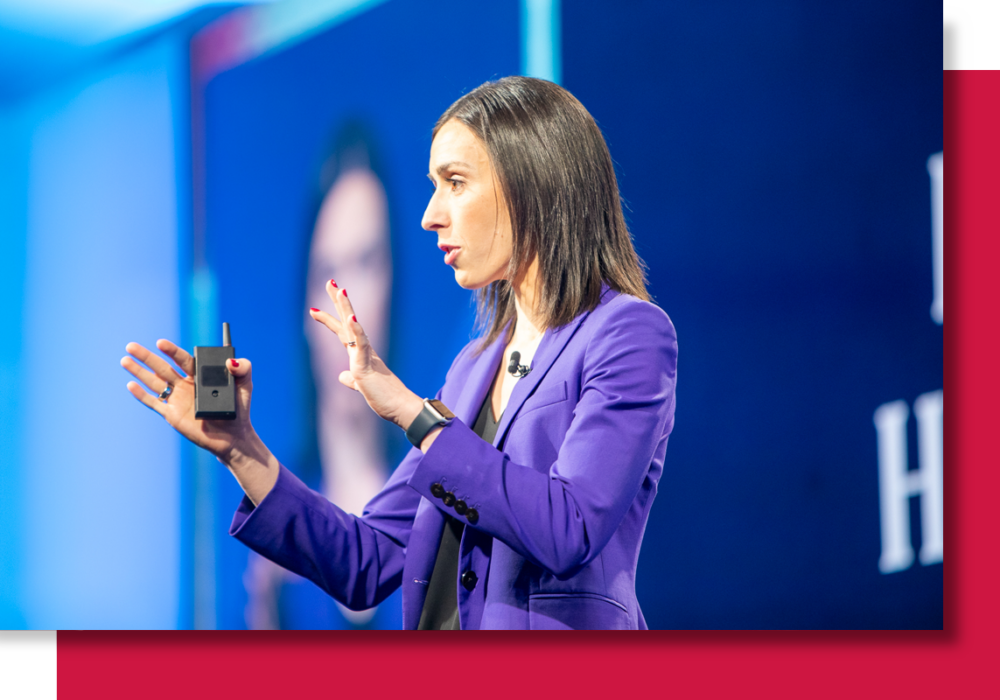
Holly Ransom is known across the world as a high-energy dynamo, whose passionate commitment to real world impact inspires audiences to turn knowledge into action. Holly spans countries, industries, and stages every year, sharing the secrets of performance and giving audiences the tools they need for change. From factory floors to the United Nations, from elite sporting clubs to Fortune 100 leadership offsites, her audiences always leave energised with a clear action plan, her talks – which receive an average 9.5 client rating – are renowned for their interactivity and connection.
See Holly in action

After nearly 30 years of putting this event together, I can genuinely say that Holly Ransom is one of the most engaging and generous speakers we’ve had.
We are so thankful we secured Holly – Her energy, passion and wisdom made our event a huge success.

Incredible! She left everyone in the room wanting more!
A truly outstanding talk which was received extremely well by our global audience.
100% on point, provided the perfect balance. Highly recommend!
I still can’t believe we managed to have Holly at our High Performance Summit; the feedback has been so great.

Sets the bar extremely high… engaging, thoughtful, and passionate.

If you’re looking for a speaker who cuts through with brilliant content, riveting stories and a clear path to making changes, then book Holly.
Holly’s Keynotes

Perform
Attention, Meaning & Action Moving Together Under Pressure
The best teams aren’t the ones trying hardest — they’re the ones where attention, meaning, and action move together under pressure. For teams already striving for greatness, closing the gap between these critical systems is the next frontier. This keynote helps teams see and adjust their invisible performance architecture: which of your three systems is quietly costing you, and how can you rebuild it?
- Unlocking attention, meaning, and action inside your team — the core idea behind performing your best under pressure.
- Diagnosing the enemies of performance and protecting your three systems.
- Moving from overload to clarity to action, by design, not by luck.

The Attention Advantage
Directing Focus When Everything Is Competing For It
Attention is finite, but the places you can direct it are infinite. This is not a willpower problem — it’s a design problem, and the modern world is built to exploit it. The highest performers aren’t the ones with more attention-discipline than everyone else; they’re the ones who have built a deliberate practice for choosing where their attention goes, protecting it from other demands, and restoring it when it inevitably breaks. This keynote unpacks that practice, showing individuals and teams how to direct attention on purpose instead of reacting to whatever’s loudest.
- Directing attention deliberately not reactively.
- Protecting attention from everything — deprioritization is a discipline, not a failure of will.
- Restoring attention when it breaks, so lost focus doesn’t compound into lost momentum.
- Scaling focused attention from an individual habit into a team capability.

Built for Performance Under Pressure
Pressure is not the enemy of performance — it’s one of its biggest drivers. This keynote explores the relationship between pressure and performance: why you need some stress to perform at our best, why uncertainty derails us, how to build tolerance for high-stakes situations, and what quality reps a team needs to compound performance over time.
- Why coherence under pressure — not pressure itself — determines whether performance holds.
- Why uncertainty stalls us and what to do about it.
- How tolerance is built as a practice, not inherited as a personality trait.
- What quality reps actually look like, and why most high-stakes preparation misses the point.

Own It
Moving From Clarity to Committed Action
Most organizations are better at making decisions than they are at owning them. This keynote is about what happens after the meeting ends: how you move from clarity to committed action, who owns what by when, and how you build the rhythm and narrative that stops the new being swallowed by the now.
- Clarity of ownership is the entry point to execution, not the finish line its often treated as.
- Starting is predicated on stopping: what has to end before something new can take hold.
- Inherited structures carry the fingerprints of old priorities — behaviors built for yesterday may be quietly working against today’s plan.
- Momentum requires structure — and a sense of play.
Make it Matter
Building the Meaning That Creates Your Team’s Movement
Most alignment problems are meaning problems in disguise — teams operate on an assumed shared understanding that was never actually shared. This keynote teaches how high-performing teams build genuine shared meaning: not by avoiding friction, but by using it. The result is decisions people actually own, built on genuine buy-in, not assumed agreement.
- Ensuring that understanding is built together, not assumed.
- Real alignment requires productive friction, not consensus — surfaced early, resolved deliberately.
- Decisions that show their work earn their authority.
- Change moves at the pace of trust, not the plan: story makes change tangible enough to motivate people.