
Jacinda Ardern — Transitions
The first time I met Jacinda Ardern — the former Prime Minister of New Zealand, who rose to lead her country at just 37 — she reached to shake my hand and said, “You realise if you grew your hair out, you could be my doppelgänger.” People make that joke to me fairly often — I don’t see it myself, if I’m honest — but I certainly didn’t expect her to be the one who made it. The second time, she pointedly mentioned she’d worn her hair up so we’d look less alike. Most recently, she’s gone a shade or two darker — so much for the two of us as lookalike, fellow dark brunettes.
That first meeting stayed with me for another reason, too. I was interviewing Jacinda alongside Sanna Marin, the former Finnish prime minister — two women who’d each led their countries in their 30s. My grandmother had passed twelve months earlier, and I wished more than anything I could call her and tell her about it. We used to talk about intergenerational progress — the choices open to my generation that weren’t open to hers. Confined to a choice between nurse, teacher, or typist, she would have marvelled at what these two women had done.
Beyond what that day represented, what has struck me in every conversation since is her eloquence, poise, warmth, and thoughtfulness. But when we spoke last month — eighteen months on from our previous conversation — I was struck by something else: how fully she has embraced her next chapter while still drawing on the one before it, using the rearview mirror to inform what’s next, and, unmistakably, to inspire others to go make their own mark. I left feeling a sense of grounded optimism, challenges acknowledged but upbeat all the same. It’s what led me to write about the idea of transitions for my first piece as a contributing columnist for Forbes. Here’s a taste of it.
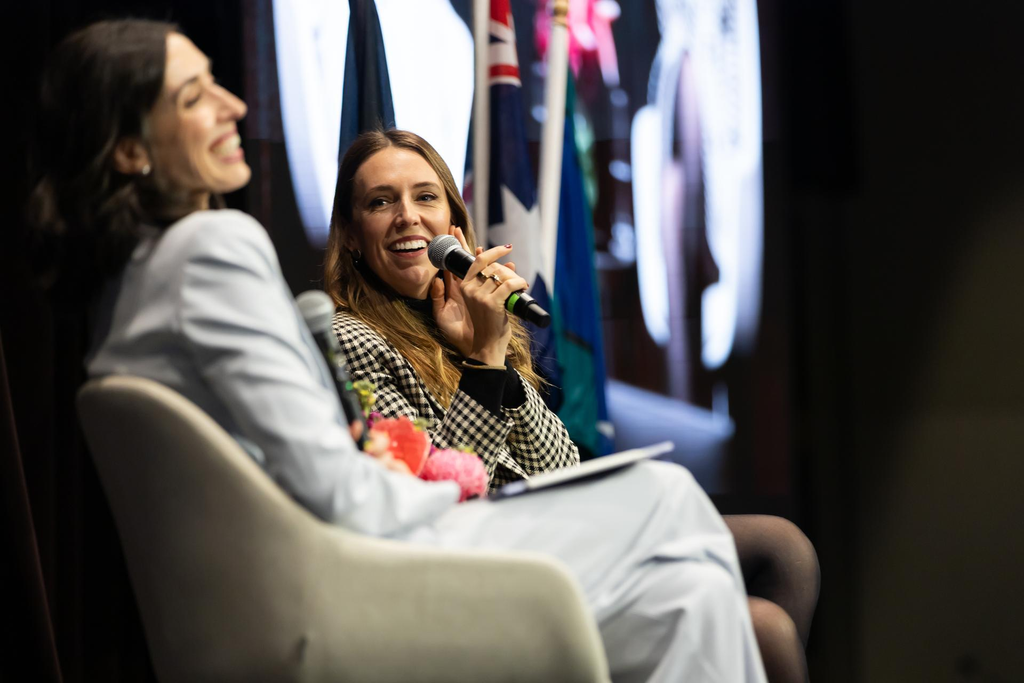
Jacinda Ardern & The Difficult Middle Part of a Transition
The night before Jacinda Ardern announced she was resigning as Prime Minister of New Zealand, she sat down with the president of her party and told her, in full, why she was leaving. The president took it in, then asked what she was going to tell the country. Ardern still remembers being almost startled by the question, as if it had never occurred to her that the answer could be anything other than what she’d just said. “The same thing I just told you,” she said. No second version, rehearsed and softened for public consumption. People kept looking for one anyway, certain that an account so plain had to be hiding something more dramatic. It wasn’t. She had made peace with her reasons before she ever spoke them out loud, and she never needed anyone else to agree.
Ardern told me this when we sat down together last week, and it’s stayed with me since. Most writing about career transition treats it as a logistics problem: what you do next, what you call yourself, what goes on the next business card. Her real insight was that the harder part isn’t logistics. It’s authorship.
It’s an idea I return to often in my own writing. In my book, The Leading Edge, I quote the Harvard scholar Marshall Ganz, who puts it more bluntly than I ever have: “If we don’t author our story, others will, and may tell our story in ways that we may not like. Not because they are malevolent, but because others try to make sense of who we are by drawing on their experience of people whom they consider to be like us.” That’s the assumption Ardern kept running into, even from people close to her. Not malice. Just how most people expect a story like that to work.
She offered two more ideas in the same vein. The first: resist the pressure to make “next” look like “last.” When you leave a big job, she told me, there’s an unspoken expectation that you justify it by doing something equally big next, otherwise it looks like the leaving wasn’t fully intentional, or like you weren’t capable of more. She had to consciously stop measuring her next chapter against the size of the one she’d left. The second: ask a different question entirely, not what her next title should be. Neither is a strategy. Both are ways of taking the pen back.

The Missing Middle
There’s a reason this territory is so under-mapped, even for someone as reflective as Ardern. In 1988 the sociologist Helen Rose Fuchs Ebaugh, herself a former nun, published “Becoming an Ex: The Process of Role Exit,” interviewing 185 people leaving roles that had defined them, nuns, convicts, spouses, retirees. What she found was a rough, repeatable shape to it, regardless of the role, and it’s still where transition research starts.
A 2026 review in the Annual Review of Organizational Psychology and Organizational Behavior, by Herminia Ibarra and colleagues, went back through 25 years of research since Ebaugh and found an uncomfortable gap. Almost nobody studies the whole arc, most studies pick one phase and stop. And most of it is about people who were pushed, not people who chose to go, even though voluntary transitions, like Ardern’s, are fast becoming the norm.
I don’t think that gap is a coincidence. The liminal stretch is exactly where the authorship fight happens, and it happens almost entirely out of view. Nobody publishes a memo about who they are between roles. You just live it.
The Story I Couldn’t Say Out Loud
I know that stretch personally. In 2015 I was Chief of Staff at a major bank when I decided to leave, without anywhere better to go. I gave myself three months to work out what was next, a decision that eventually led me to start the business I still run eleven years later. What I remember most isn’t the uncertainty. It’s the lies of omission. Every time someone asked where I was going, the honest answer, “I don’t know yet. I’m giving myself time to find out,” felt impossible to say out loud, because the assumption underneath the question was so obvious: nobody leaves a job like that unless it’s for something better. I had already made peace with my reasons. It was everyone else’s version of my story I hadn’t worked out how to survive.
Read the rest of the piece at Forbes.
Enjoyed reading this? Share the love!