Why You Should Run Your Business Like a Circus
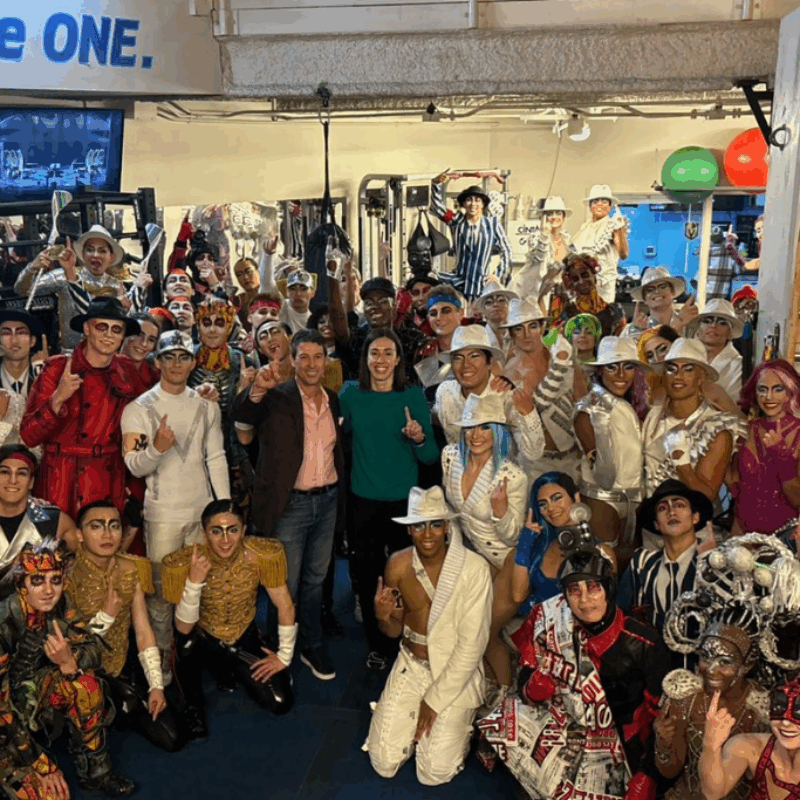
Duncan Fisher runs one of the most complex operations on the planet. And he’s got a message for every business leader: you should be running your business like a circus.
I know how that sounds. When most people say “this place is a circus,” they mean chaos.
But Duncan means the opposite. And last month in Vegas at IMEX America, I got to find out exactly what he’s talking about.
As Chief Show Officer at Cirque du Soleil, Duncan’s running an operation that defies easy comparison:
- 8,000+ performances a year across 6 continents, reaching 10 million+ people annually
- 4,000+ team members, including 1,200 elite artists speaking 36 languages from 80+ nationalities
- High-stakes operations where aerialists trust someone to catch them 40 feet in the air, every single night.
Now I know what you’re probably thinking, “Holly, my team isn’t catching people mid-air. How does this apply to me?”
Your operation might not involve flying trapeze artists, but the pressure and challenges are the same.
Distributed teams that need to perform flawlessly. Cultural differences that could tank collaboration. Trust that can’t afford to break. And disruptions—like a pandemic—that can obliterate your entire model overnight.
Which is exactly what happened to Cirque in 2020.
From Bankruptcy to Better Than Before
In 2020, COVID hit Cirque the same way it hit businesses across industries. Every show stopped. Zero audience meant zero revenue, and the company filed for bankruptcy.
Yet just nine months later, they launched their first show and within 18 months, all Cirque du Soleil shows were back on the road across five continents.
Fast forward to today, they’re not just back. They’re better than before the pandemic.
How do you orchestrate a comeback like that?
That’s exactly what Duncan broke down when we sat down together.
And what he shared wasn’t just for showbiz. It was a leadership framework for anyone chasing high performance in an unpredictable world.
How To Run Your Business Like a Circus: The Three Cs
Cirque’s vision is simple: to entertain the world. Ambitious? Absolutely.
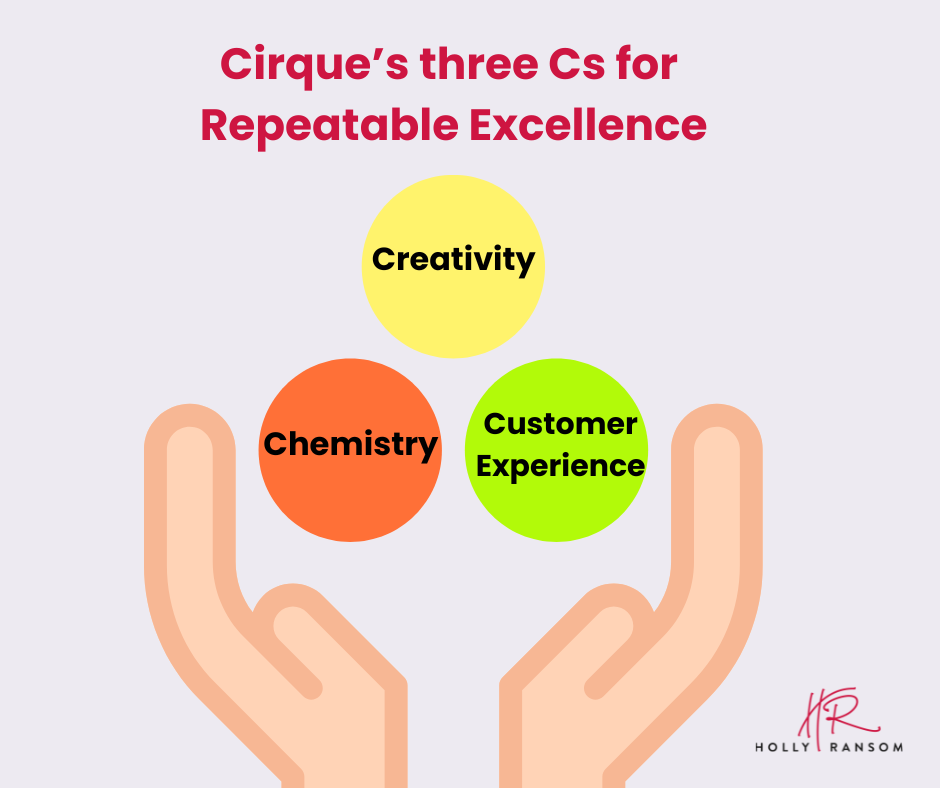
But Duncan explained that achieving an extraordinary ambition requires mastering three levers simultaneously—what he calls the Three Cs: Creativity, Chemistry, and Customer Experience.
Think of them as juggling balls. Drop one, and the whole performance falters. Keep all three in motion, and you create something extraordinary.
Here’s how each one works:
Creativity unleashes potential and pushes boundaries. It’s what allows you to reimagine what’s possible when the old playbook stops working.
Chemistry builds the foundation for trust and creates the conditions where people can do their best work. When the stakes are high, chemistry is what allows ambitious aspirations to be realised.
Customer Experience ensures that if you can’t surprise and delight your customer, it doesn’t matter how good the first two are. Execution matters, but flawless execution that moves people matters more.
At Cirque, these three elements work in sync to shape how decisions are made, how teams perform under pressure, and how audiences are deeply moved. It’s a framework designed for performance, clarity, and connection—and it holds lessons for any organisation aiming to lead at the highest level.
1. Creativity: The High-Wire Act Your Business Can’t Skip
Picture this: A hurricane is bearing down on your touring production. Or critical equipment fails 20 minutes before curtain. Or you need to completely redesign your set halfway through a world tour.
These are the types of issues that can arise at any time when you’re running 8,000 performances a year across six continents.
Which means creativity can’t be confined to the stage.
It has to live everywhere: in the rigging crew troubleshooting a mechanical failure, in the logistics team rerouting shipments, in the costume department adapting designs on the fly.
Survival depends on every role bringing creative problem-solving, not just artistic vision.
Yet Duncan believes most companies suffocate this kind of thinking the moment different teams try to work together.
“The creative types say ‘let’s try this!’ and the operations folks respond ‘step one, step two, we’ve always done it this way,'” he explained. “They can’t hear each other.”
Duncan bridges both worlds. A former gymnast who became an executive, he’s what he calls “bilingual”—fluent in both creative vision and operational reality. And he believes every leader needs to develop this same capability:
“Why can’t we teach operations people to understand creatives, and creatives to understand operations? When they speak the same language, they solve problems neither could crack alone.”
At Cirque, creativity isn’t siloed in one department. It’s a discipline everyone owns.
The Shift Happening Right Now
The World Economic Forum’s Future of Jobs Report 2025 ranks creative thinking as the 4th most critical skill for the next five years—ahead of analytical thinking and programming.
That’s not surprising when you consider what leaders are actually facing: market shocks without precedent, teams spread across timezones, customers whose expectations evolve monthly – and none of this comes with a playbook.
And, as AI absorbs routine work, three human capabilities become irreplaceable: imagination, intuition, and connecting ideas across domains.
Leaders who build this throughout their organisations won’t just survive disruption. They’ll define what comes next.
How Cirque Protects Good Ideas (Even Bad Ones)
When someone brings Duncan an idea—even one that seems completely unworkable—he asks two questions that change everything:
- “Why does that idea speak to you?” (uncovers the real problem)
- “What would have to be true for this to work?” (explores possibility)
The first surfaces better solutions. The second transforms dismissal into breakthroughs.
It’s a perfect example of psychological safety in action. If people feel safe to bring every idea, you hear the real problems sooner and you find options faster.
Print these two questions and stick them somewhere visible before your next brainstorm. They’re the fastest way to shift from idea killer to idea builder.
2. Chemistry: Trust That Survives the High Wire
When Duncan spoke about chemistry, he wasn’t talking about team bonding exercises or Friday drinks. He was describing something far more fundamental: the kind of trust that holds under extreme pressure.
“My teams will trust each other with their lives, truly,” Duncan said—and after seeing the show, I believe him.
Performers are launched through the air with terrifying precision. But they’re not the only ones the system depends on.
There’s the rigger who built the apparatus in a car park a week ago. The lighting technician calling cues in real time. The stage manager coordinating 50 moving parts simultaneously. One miscalculation, one miscommunication, and the entire operation unravels.
For most organisations, the stakes aren’t life or death. But the principle holds: when pressure rises, chemistry is what keeps performance from collapsing. It’s what allows your team to execute flawlessly when the margin for error disappears—whether that’s a product launch, a market pivot, or a crisis that demands rapid decisions with incomplete information.
So how does that kind of trust get built?
Through what Duncan calls “shared consciousness”—a term borrowed from General Stanley McChrystal’s book Team of Teams. It means a shared understanding of purpose, values, and how decisions get made.
It empowers people to act quickly and correctly, even under pressure. At Cirque, that shared understanding comes down to two sacred, non-negotiable goals:
- Everyone gets home safely (performers and audience).
- The audience has the time of their lives.
Simple. Clear. Non-negotiable.
How Shared Consciousness Enables Radical Empowerment
Here’s where it gets powerful: this shared consciousness enables radical empowerment.
During COVID, Duncan’s team shut down everything—1,500 performers sent home, 600 sea containers into storage. When it was time to relaunch, he was told it couldn’t be done. Head office didn’t have the capacity to coordinate a comeback at that scale.
So they changed their approach entirely.
Instead of controlling everything from Montreal, they tasked each show team with relaunching themselves.
“We put them in the driver’s seat, provided assistance, guidance, and parameters. Then let them execute.”
This wasn’t just a crisis response. It was a recognition of reality: the sun never sets on Cirque du Soleil. With shows running simultaneously across six continents, centralised control had always been a bottleneck. In a crisis, it became impossible.
But Duncan’s teams could only execute independently because they’d already built the infrastructure for shared consciousness. One of their key mechanisms? Horizontal teams.
Cirque connects people in similar roles across shows and geographies. Lighting directors talk to lighting directors. Stage managers to stage managers. They share what’s working, what’s breaking, what they’ve learned.
This creates a distributed intelligence network. When Tokyo solves a rigging challenge, Montreal and Melbourne know within days. Problems get solved faster. Best practices spread organically. When a crisis hits, teams already have the relationships and shared language to move quickly.
The Trust Advantage in Hard Numbers
Everyone knows trust matters. The question is: how much?
According to the 2025 Great Place To Work Effect Playbook, high-trust companies:
- Generate 8.5x more revenue per employee (Great Place To Work, 2025)
- They grow 5.5x faster through innovation and agility
- And they outperform the stock market by over 3x
Trust is a force multiplier for performance, innovation, and resilience.
Two Ways to Build Shared Consciousness:
- Define your North Star
What are the sacred goals everyone on your team needs to understand and protect? Make them simple enough that anyone could repeat them. - Build horizontal teams
Connect people in similar roles across locations or departments (your finance leads in different regions, your customer success managers across divisions). Give them a recurring 45-minute call with one agenda:- What’s working?
- What are you struggling with?
- What did you try that others should know about?
Because when your internal network is strong, your learning is fast, your trust is high, and your reinvention is constant.
3. Customer Experience: Orchestrate Wonder, Not Just Delivery
Customer experience at Cirque starts in the car park and ends when you exit it.
But here’s what most organisations get wrong: they invest in the spectacular while ignoring the foundational.
“You can spend millions on experiences, decor, apps, digital screens,” Duncan said. “But if the toilets are dirty, none of that matters.”
It’s the business equivalent of launching a brilliant new product feature while your customer service line keeps people on hold for 45 minutes. Or unveiling a stunning rebrand while your invoicing system still sends duplicate bills. The flashy stuff might get attention, but the fundamentals are what people actually remember.
One story he shared stood out: it was about a university professor who attended a show six months prior. When Duncan asked what she remembered, it wasn’t the guy on the wheel of death. Not the triple somersault on one stilt.
It was the usher who brought her child a booster seat without being asked.
“You tap into people’s feelings and they will remember you for it,” Duncan said.
At Cirque, front-of-house staff are empowered to act. They carry a “menu of magic” they can use:
- Free drink vouchers
- Seat upgrades
- Small surprise gestures that make a moment memorable
“We can spend millions on chatbots, and we should. But nobody’s going to remember that in six months. You tap into feelings? They’ll remember it forever.”
Stop Innovating Around Broken Basics
Everyone’s racing to be first with AI-powered this and hyper-personalised that. Meanwhile, your customers are still on hold for 20 minutes and getting charged twice for the same order.
The data tells a different story about what actually moves the needle:
According to Qualtrics’ 2024 Global Consumer Study:
- Customers who have an “excellent” experience are 3.6x more likely to recommend a brand.
- And, they’re 3x more likely to trust that brand long-term.
And it pays off: Customer-centric companies are 60% more profitable than those that aren’t (Deloitte)
Two Ways to Elevate Customer Experience:
- Do the Fundamentals Audit
Walk your customer’s journey like a stranger—car park to exit. Where do things break down? Where’s the friction your team has learned to ignore but customers experience fresh every time? - Ask Your Front Line
“What’s the one thing customers complain about that we could fix but haven’t?” Their answer will tell you exactly where your blind spots are.
Try This: Walk your customer’s full journey this week. Don’t skip the car park, the bathroom, or the wait times. What would you complain about if you were them?
Technology Enhances, but Humans Endure
James Cameron knows a thing or two about creating unforgettable experiences. The director behind Avatar, Titanic, and The Terminator has built a career on pushing the boundaries of what’s possible on screen.
After watching a Cirque show, Duncan took him backstage. What Cameron said next captured everything Duncan had been building toward:
“I love what I do. The technology we make films with is incredible. But I have no idea what we’re going to be using in five years. But 1,000 years from now, somebody will be able to watch one of your shows and still be amazed. Because the human element takes precedence.” – James Cameron
Cirque leans into AI. They use cutting-edge technology constantly. But they also employ more Olympians (around 25 currently, nearly 90 in their history) than any company in the world.
“We wrap our people in technology,” Duncan said. “We don’t overpower them with it.”
In a world obsessed with the next tech breakthrough, maybe the real competitive advantage is simpler:
- Protect creative time like it’s your most valuable asset
- Build trust deep enough to empower decisions
- Remember that customers feel the fundamentals before they notice the spectacle.
Want to Lead with More Creativity, Trust, and Impact?
Ask yourself:
Which of the Three Cs is weakest on your team right now?
Then choose one conversation, one decision, or one ritual this week to shift it.
Because leadership isn’t magic. But like any performance worth watching, it requires deliberate practice.
P.S. For my Conversations That Matter subscribers: Open the email that brought you here and you’ll see the Three Cs Audit—a brief guide to help you score your team and take action this week.