
The Simone Biles Guide to Resilient, Human-Centred Leadership

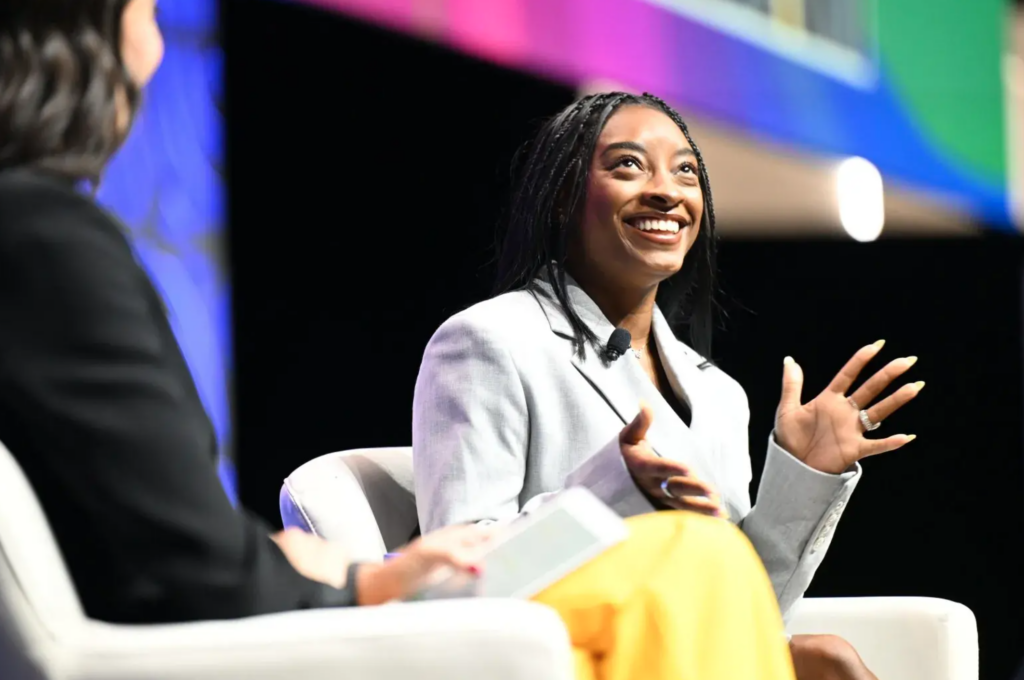
A few weeks ago, I had the immense privilege of sitting down with the incredible Simone Biles on the ATD main stage in Washington DC. Just last year, I’d watched her Netflix documentary Rising in total awe—now here I was, sharing the stage with her.
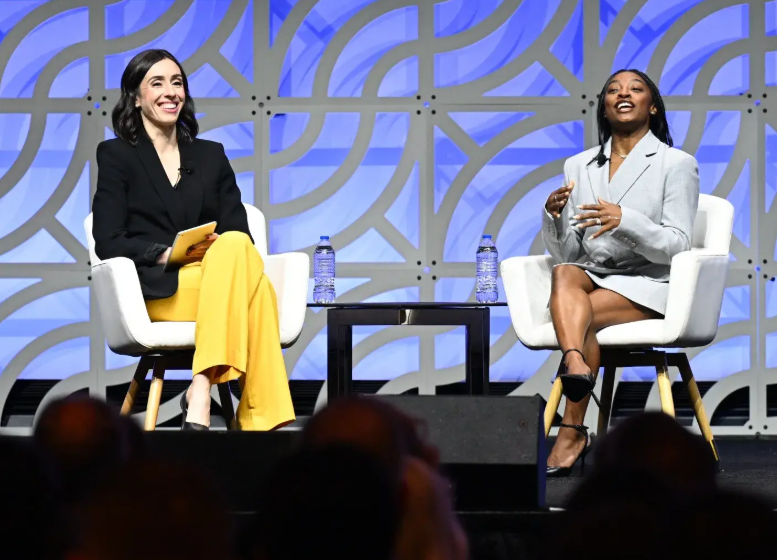
Now, Simone Biles needs no introduction—but I’ll give you one anyway because it’s worth pausing on. We’re talking 11 Olympic medals (7 of them gold), 30 World Championship medals, and not one, not two, but five skills named after her—yes, five. Across floor, vault, and beam. Her name is forever etched into the fabric of the sport.
But Simone’s legacy isn’t just measured in medals or skills.
Thanks to her decision to step back during the Tokyo Olympics, she didn’t just protect her own wellbeing—she changed the global conversation around mental health in elite sport. And she didn’t pretend to be the first. She gave props to Naomi Osaka, who’d done the same at the French Open just months earlier.
Then, after stepping away to heal, reflect, and reset—not just physically but mentally—Simone returned with a bang. She claimed four golds and a bronze at the 2023 World Championships, took home the ESPY for Best Comeback Performance in 2024. Then, just in case the world needed a reminder that she’s still the GOAT, Simone delivered another history-making performance at the Paris Olympics with four medals, three of them gold.
Redefining Success in Leadership
Simone doesn’t just represent excellence—she redefines it. She’s grounded, funny, wildly accomplished, and refreshingly human. Her approach invites us to rethink success—not as relentless output, but as something more sustainable, intentional, and real.
Over the past decade, I’ve had the privilege of working with elite athletes and high-performing teams across the globe. And if there’s one thing I’ve learned, it’s this: the best don’t just perform—they build the systems that make performance repeatable.
Here are four leadership lessons Simone shared that every high-performing team—and the leaders behind them—need to hear right now.
1. Simone Biles Didn’t Set Out to Win Gold—She Set Out to Grow
Now, this revelation Simone shared with me might surprise you: she never once set a goal to win a gold medal.
She’s a prolific goal-setter, yes—but the goals were always about the process: showing up, doing the work, growing day by day. As her mum told her early on:
Be a better version of yourself tomorrow than you were today.
That mantra became her north star. For Simone, success was measured by effort, not outcome.
She shared a moment where she placed seventh—and still felt like a winner because she’d shown up. She’d pushed through. She’d done the work. And on the flip side? There were golds that didn’t feel like real victories, because she knew she hadn’t performed at her best.
That’s because Simone wasn’t driven by the scoreboard—she was driven by the standard she set for herself. A standard rooted in preparation, presence, and progress.
We talk a lot about results in leadership—targets hit, KPIs met, boxes ticked. But that kind of fixation can build pressure and actually erode performance.
Dr. Sian Beilock, a leading cognitive scientist, revealed in her book Choke that the highest performers don’t obsess over results. They zero in on the controllables: breath, technique, routine. The things they can actually influence in the moment.
That’s the power of process focus. It grounds you and calms your brain. It makes performing under pressure less about surviving the spotlight and more about doing what you’ve trained to do.
2. Simone’s Secret Weapon? Fun (and Variety)
Simone shared that she performs best when she’s having fun. She laughed about being the kid who’d be gossiping with teammates one minute, then casually land a triple-double like it was nothing.
Her coaches embraced it. They knew joy and variety weren’t soft—they were essential. They built levity into training. Switched things up. Let her lead. Because they knew: a mentally fresh athlete is a better-performing one.
Studies back this up. Playfulness, novelty, and rhythm-switching keep teams engaged, sharp, and adaptive. They fight fatigue and spark creativity. They build cultures where people want to keep showing up.
If you want sustainable high performance, you need to design for energy—not just efficiency.
You can hear Simone reflect on her time with a former coach—and how she wasn’t allowed to have fun or fully be herself—in this clip below.
3. Simone’s Tokyo Moment: A Masterclass in Psychological Safety
In Tokyo, Simone made a decision that shook the world: she pulled out of competition to protect her mental health.
At the time, Simone was experiencing what gymnasts call “the twisties”—a terrifying phenomenon where they lose their sense of spatial awareness mid-air. Imagine launching yourself into a high-speed, gravity-defying spin, and suddenly not knowing which way is up. It’s not just disorienting—it’s extremely dangerous.
Rather than push through and risk catastrophic injury, Simone made the call to bow out.
The backlash was immediate and brutal.
She was labelled a quitter. Accused of letting her country down. Her mental toughness was questioned by people who had never stood where she stood—mid-air, mid-spin, with the world watching.
But Simone stood firm. And her decision didn’t just protect her—it paved the way for others.
Before Tokyo, stepping back for mental health could cost your team everything. After Tokyo, the rules changed. Athletes can now prioritise wellbeing without jeopardising their teammates’ results.
As she shared on stage, “I couldn’t have done what I did in Tokyo under the old regime,” she said. Her former coaching environment was, in her words, “militaristic.”
But in Tokyo, she had a team who genuinely listened. Who trusted her to know what she needed. Who created the space for her to say, “I’m not okay”—and didn’t punish her for it.
“We also have to focus on ourselves, because at the end of the day we’re human, too, so, we have to protect our mind and our body, rather than just go out there and do what the world wants us to do.” – Simone Biles
The Business Case for Psychological Safety in Leadership
Simone’s Tokyo moment was a textbook case in psychological safety.
Harvard’s Amy Edmondson calls it the secret sauce of high-performing teams. Google’s Project Aristotle found the same thing. Out of everything they studied, psychological safety was the #1 predictor of team effectiveness.
When people feel safe to speak up, screw up, ask for help, or say, “I’m not okay”—performance doesn’t fall. It soars.
We’re leading in a world where pressure is high and the margin between resilience and burnout is razor-thin. If your team can’t speak up safely, you’re not building strength—you’re building fragility.
4. Simone’s Reminder: You Don’t Have to Break to Ask for Help
Simone believes with every fibre of her being:
You’re worthy of help. You deserve support.
Not just athletes. Everyone. Leaders included.
You don’t have to be at breaking point. You don’t have to tick some invisible box of exhaustion or crisis to earn support. You’re worthy of it because you’re human.
And the strongest leaders are the ones who know when to lean in, speak up, and make it okay for others to do the same.
Bringing Simone’s Lessons to Life: Try This With Your Team
Simone Biles’ story isn’t just extraordinary—it’s instructive. It challenges how we think about performance, resilience, and leadership itself.
Here’s how to translate Simone’s approach into your leadership practice starting this week.
1. Make Process the Hero
Before sprinting into deliverables, zoom out: What does great process look like for us right now? Not just what we do—but how we do it.
Try setting team process goals like:
- “Let’s give each other faster, clearer feedback.”
- “Let’s create one deep-work block each week—no meetings.”
- “Let’s name it when we’re at capacity, instead of pushing through.”
- “Let’s celebrate how we supported each other—not just what we delivered.”
Small shifts. Big impact.
2. Foster Joy, Embrace Variety
In high-performing environments, it’s easy to get caught in a cycle of discipline, delivery, repeat. But even the most elite teams lose their edge—and their energy—without room for joy and variety.
Simone’s story mirrors what high-performing teams like the Golden State Warriors—one of the most successful NBA teams of the past decade—have built into their culture. Coach Steve Kerr embedded joy as a core value, insisting that the team not only execute with excellence, but also enjoy the game.
Joy isn’t the reward for success—it’s the fuel for it. And variety is part of the formula. New challenges, fresh formats, playful rituals—they keep teams sharp, engaged, and adaptable. They fight fatigue, spark learning, and create the kind of connection no spreadsheet can capture.
This month, ask your team:
“What’s one simple way we could mix things up to make work feel more energising?”
Here are a few easy wins:
- Rotate who leads your weekly meeting
- Share a quick insight from another team or department
- Switch up how you celebrate wins (bonus points for creativity)
- Kick off with a “what made you smile this week?” check-in
Small, intentional moves that say: We value energy. We make space for joy. We’re in this together.
And over time? They’re what create the conditions for teams to perform at their peak—and want to keep showing up.
3. Lead the Environment, Not Just the Task
Simone could only make her Tokyo decision because she was in an environment that made it safe to speak up. The same goes for our teams.
High performance happens because of the culture—not in spite of it.
Earlier this year, Brené Brown shared with me a simple yet powerful check-in she uses with her team: before kicking off a meeting, she asks everyone to share how they’re feeling in just two words.
It sounds small, but it opens the door to honesty without making things heavy—and gives you a read on how people are really showing up that day. I wrote about it here—it’s a practice I think more leaders would find surprisingly useful.
The Heart of High Performance
Simone’s story reminds us that real, lasting excellence doesn’t come from pressure, perfectionism, or pushing endlessly for peak performance. It comes from something far more powerful—and far more human. It’s built on:
- Self-awareness over ego
- Process over outcome
- Joy and variety as a strategy, not just a reward
- Environments built on trust, not control
- Leaders brave enough to pause, speak up, and reshape the system—not just for themselves, but for everyone who comes next.
This isn’t just a new definition of success. It’s a better one. And it’s the kind of leadership the world needs more of—on the mat, in our teams, and far beyond.